 Add to Chrome
 Add to Firefox
 Add to Edge
Uncertainty-Aware Gaussian Map for Vision-Language Navigation
May 26, 2026
Vision-Language Navigation (VLN) requires an agent to navigate 3D environments following natural language instructions. During navigation, existing agents commonly encounter perceptual uncertainty, such as insufficient evidence for reliable grounding or ambiguity in interpreting spatial cues, yet they typically ignore such information when predicting actions. In this work, we explicitly model three forms of perceptual uncertainty (i.e., geometric, semantic, and appearance uncertainty) and integrate them into the agent's observation space to enable informed decision-making. Concretely, our agent first constructs a Semantic Gaussian Map (SGM), composed of differentiable 3D Gaussian primitives initialized from panoramic observations, that encodes both the geometric structure and semantic content of the environment. On top of SGM, geometric uncertainty is estimated through variational perturbations of Gaussian position and scale to assess structural reliability; semantic uncertainty is captured by perturbing Gaussian semantic attributes to reveal ambiguous interpretations; and appearance uncertainty is characterized by Fisher Information, which measures the sensitivity of rendered observations to Gaussian-level variations. These uncertainties are incorporated into SGM, extending it into a unified 3D Value Map, which grounds them as affordances and constraints that support reliable navigation. Comprehensive evaluations across multiple VLN benchmarks show the effectiveness of our agent.

3D Gaussian Map with Open-Set Semantic Grouping for Vision-Language Navigation
May 26, 2026Vision-language navigation (VLN) requires an agent to traverse complex 3D environments based on natural language instructions, necessitating a thorough scene understanding. While existing works equip agents with various scene representations to enhance spatial awareness, they often neglect the complex 3D geometry and rich semantics in VLN scenarios, limiting the ability to generalize across diverse and unseen environments. To address these challenges, this work proposes a 3D Gaussian Map that represents the environment as a set of differentiable 3D Gaussians and accordingly develops a navigation strategy for VLN. Specifically, Egocentric Scene Map is constructed online by initializing 3D Gaussians from sparse pseudo-lidar point clouds, providing informative geometric priors for scene understanding. Each Gaussian primitive is further enriched through Open-Set Semantic Grouping operation, which groups 3D Gaussians based on their membership in object instances or stuff categories within the open world, resulting in a unified 3D Gaussian Map. Building on this map, Multi-Level Action Prediction strategy, which combines spatial-semantic cues at multiple granularities, is designed to assist agents in decision-making. Extensive experiments conducted on three public benchmarks (i.e., R2R, R4R, and REVERIE) validate the effectiveness of our method.
Clinically-Grounded Counterfactual Reasoning for Medical Video Diagnosis
May 26, 2026Medical video diagnosis involves inferring clinical decisions from dynamic tissue responses throughout examination processes. Existing methods rely on an end-to-end learning paradigm that i) focuses on appearance rather than pathology, ii) lacks clinical priors, and iii) reasons solely from observations without counterfactual comparison. This work introduces MedVCR, a counterfactual reasoning framework that mimics clinical diagnostic thinking. MedVCR comprises three components: a Counterfactual Generator that synthesizes tissue evolution under specified pathological states via a diffusion-based manner; a Counterfactual Representation Learning module that encodes diagnostic knowledge through clinical rules (i.e., temporal consistency, pathological separability, and counterfactual alignment); and a Dual Diagnostic Prediction strategy that integrates video-level assessment with frame-level counterfactual analysis. MedVCR is evaluated under both fully supervised (e.g., colposcopy) and weakly supervised (e.g., colonoscopy) video diagnosis settings, yielding 2.6%-10.2% performance gains compared with leading baselines. Comprehensive ablation studies further validate the effectiveness of each component. The code will be released.
AxiomOcean: Forecasting the Three-Dimensional Structure of the Upper Ocean
May 11, 2026Short-term ocean forecast skill depends strongly on the three-dimensional ocean structure of the upper ocean, which governs stratification, subsurface heat storage, and the response of the ocean to atmospheric forcing. However, AI ocean forecasting models often fail to preserve this vertical structure, resulting in over-smoothed subsurface features and weak physical consistency under strong forcing. Here, we present AxiomOcean, a global AI ocean forecasting model that explicitly represents vertical hierarchy and cross-layer dependence within the water column. By combining a fully three-dimensional encoder-backbone-decoder architecture with surface atmospheric forcing, AxiomOcean jointly predicts upper-ocean temperature, salinity, and three-dimensional currents at global 1/12° resolution down to 643 m depth. In 10-day forecasts, AxiomOcean outperforms an advanced AI comparison model across variables and lead times, reducing day-1 RMSE by approximately 20 to 35% while maintaining higher anomaly correlation. The gain is not achieved through excessive smoothing: AxiomOcean better preserves eddy kinetic energy, temperature and salinity variance. Its advantage also extends through the water column and remains evident across the equatorial Pacific, Kuroshio Extension, and Southern Ocean, yielding a more realistic reconstruction of upper-ocean heat content. These results show that explicitly preserving upper-ocean three-dimensional structure can improve both forecast accuracy and physical fidelity in AI ocean prediction.
Learning 3D Representations for Spatial Intelligence from Unposed Multi-View Images
Apr 12, 2026Robust 3D representation learning forms the perceptual foundation of spatial intelligence, enabling downstream tasks in scene understanding and embodied AI. However, learning such representations directly from unposed multi-view images remains challenging. Recent self-supervised methods attempt to unify geometry, appearance, and semantics in a feed-forward manner, but they often suffer from weak geometry induction, limited appearance detail, and inconsistencies between geometry and semantics. We introduce UniSplat, a feed-forward framework designed to address these limitations through three complementary components. First, we propose a dual-masking strategy that strengthens geometry induction in the encoder. By masking both encoder and decoder tokens, and targeting decoder masks toward geometry-rich regions, the model is forced to infer structural information from incomplete visual cues, yielding geometry-aware representations even under unposed inputs. Second, we develop a coarse-to-fine Gaussian splatting strategy that reduces appearance-semantics inconsistencies by progressively refining the radiance field. Finally, to enforce geometric-semantic consistency, we introduce a pose-conditioned recalibration mechanism that interrelates the outputs of multiple heads by re-projecting predicted 3D point and semantic maps into the image plane using estimated camera parameters, and aligning them with corresponding RGB and semantic predictions to ensure cross-task consistency, thereby resolving geometry-semantic mismatches. Together, these components yield unified 3D representations that are robust to unposed, sparse-view inputs and generalize across diverse tasks, laying a perceptual foundation for spatial intelligence.
SinkTrack: Attention Sink based Context Anchoring for Large Language Models
Apr 11, 2026Large language models (LLMs) suffer from hallucination and context forgetting. Prior studies suggest that attention drift is a primary cause of these problems, where LLMs' focus shifts towards newly generated tokens and away from the initial input context. To counteract this, we make use of a related, intrinsic characteristic of LLMs: attention sink -- the tendency to consistently allocate high attention to the very first token (i.e., <BOS>) of a sequence. Concretely, we propose an advanced context anchoring method, SinkTrack, which treats <BOS> as an information anchor and injects key contextual features (such as those derived from the input image or instruction) into its representation. As such, LLM remains anchored to the initial input context throughout the entire generation process. SinkTrack is training-free, plug-and-play, and introduces negligible inference overhead. Experiments demonstrate that SinkTrack mitigates hallucination and context forgetting across both textual (e.g., +21.6% on SQuAD2.0 with Llama3.1-8B-Instruct) and multi-modal (e.g., +22.8% on M3CoT with Qwen2.5-VL-7B-Instruct) tasks. Its consistent gains across different architectures and scales underscore the robustness and generalizability. We also analyze its underlying working mechanism from the perspective of information delivery. Our source code is available at https://github.com/67L1/SinkTrack.
PKINet-v2: Towards Powerful and Efficient Poly-Kernel Remote Sensing Object Detection
Mar 17, 2026Object detection in remote sensing images (RSIs) is challenged by the coexistence of geometric and spatial complexity: targets may appear with diverse aspect ratios, while spanning a wide range of object sizes under varied contexts. Existing RSI backbones address the two challenges separately, either by adopting anisotropic strip kernels to model slender targets or by using isotropic large kernels to capture broader context. However, such isolated treatments lead to complementary drawbacks: the strip-only design can disrupt spatial coherence for regular-shaped objects and weaken tiny details, whereas isotropic large kernels often introduce severe background noise and geometric mismatch for slender structures. In this paper, we extend PKINet, and present a powerful and efficient backbone that jointly handles both challenges within a unified paradigm named Poly Kernel Inception Network v2 (PKINet-v2). PKINet-v2 synergizes anisotropic axial-strip convolutions with isotropic square kernels and builds a multi-scope receptive field, preserving fine-grained local textures while progressively aggregating long-range context across scales. To enable efficient deployment, we further introduce a Heterogeneous Kernel Re-parameterization (HKR) Strategy that fuses all heterogeneous branches into a single depth-wise convolution for inference, eliminating fragmented kernel launches without accuracy loss. Extensive experiments on four widely-used benchmarks, including DOTA-v1.0, DOTA-v1.5, HRSC2016, and DIOR-R, demonstrate that PKINet-v2 achieves state-of-the-art accuracy while delivering a $\textbf{3.9}\times$ FPS acceleration compared to PKINet-v1, surpassing previous remote sensing backbones in both effectiveness and efficiency.
Iris: Bringing Real-World Priors into Diffusion Model for Monocular Depth Estimation
Mar 17, 2026In this paper, we propose \textbf{Iris}, a deterministic framework for Monocular Depth Estimation (MDE) that integrates real-world priors into the diffusion model. Conventional feed-forward methods rely on massive training data, yet still miss details. Previous diffusion-based methods leverage rich generative priors yet struggle with synthetic-to-real domain transfer. Iris, in contrast, preserves fine details, generalizes strongly from synthetic to real scenes, and remains efficient with limited training data. To this end, we introduce a two-stage Priors-to-Geometry Deterministic (PGD) schedule: the prior stage uses Spectral-Gated Distillation (SGD) to transfer low-frequency real priors while leaving high-frequency details unconstrained, and the geometry stage applies Spectral-Gated Consistency (SGC) to enforce high-frequency fidelity while refining with synthetic ground truth. The two stages share weights and are executed with a high-to-low timestep schedule. Extensive experimental results confirm that Iris achieves significant improvements in MDE performance with strong in-the-wild generalization.
History-Enhanced Two-Stage Transformer for Aerial Vision-and-Language Navigation
Dec 17, 2025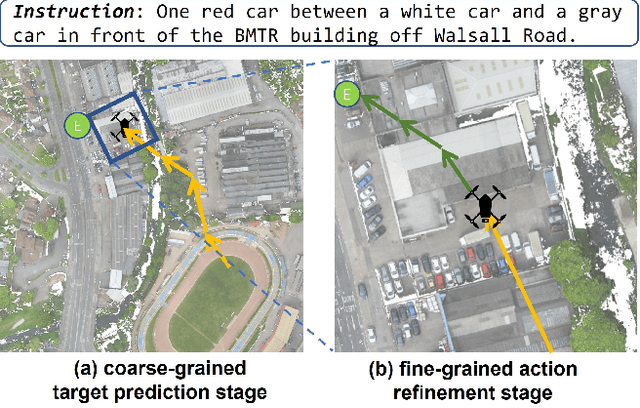
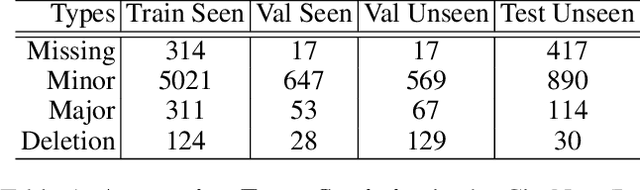
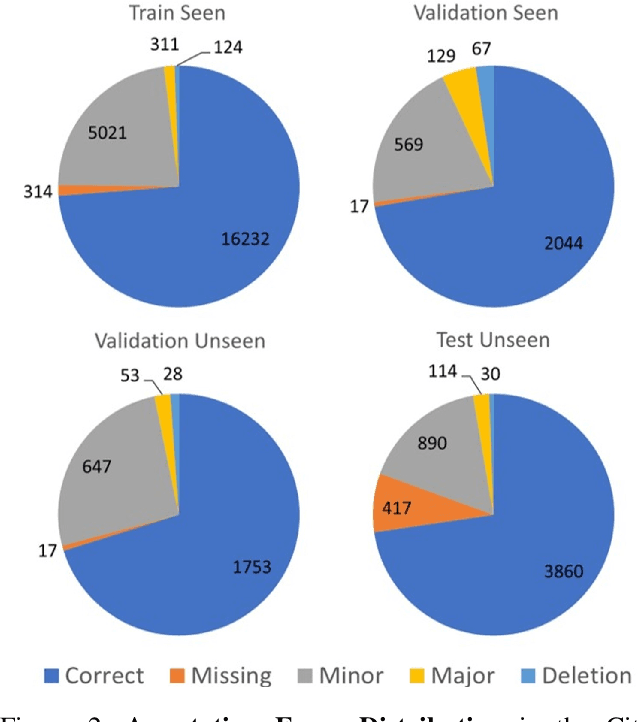
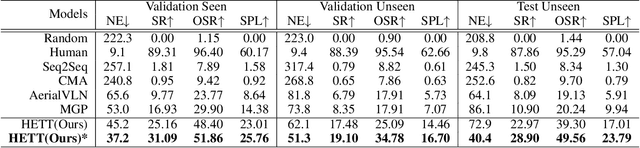
Aerial Vision-and-Language Navigation (AVLN) requires Unmanned Aerial Vehicle (UAV) agents to localize targets in large-scale urban environments based on linguistic instructions. While successful navigation demands both global environmental reasoning and local scene comprehension, existing UAV agents typically adopt mono-granularity frameworks that struggle to balance these two aspects. To address this limitation, this work proposes a History-Enhanced Two-Stage Transformer (HETT) framework, which integrates the two aspects through a coarse-to-fine navigation pipeline. Specifically, HETT first predicts coarse-grained target positions by fusing spatial landmarks and historical context, then refines actions via fine-grained visual analysis. In addition, a historical grid map is designed to dynamically aggregate visual features into a structured spatial memory, enhancing comprehensive scene awareness. Additionally, the CityNav dataset annotations are manually refined to enhance data quality. Experiments on the refined CityNav dataset show that HETT delivers significant performance gains, while extensive ablation studies further verify the effectiveness of each component.
Moving Beyond Diffusion: Hierarchy-to-Hierarchy Autoregression for fMRI-to-Image Reconstruction
Oct 25, 2025Reconstructing visual stimuli from fMRI signals is a central challenge bridging machine learning and neuroscience. Recent diffusion-based methods typically map fMRI activity to a single high-level embedding, using it as fixed guidance throughout the entire generation process. However, this fixed guidance collapses hierarchical neural information and is misaligned with the stage-dependent demands of image reconstruction. In response, we propose MindHier, a coarse-to-fine fMRI-to-image reconstruction framework built on scale-wise autoregressive modeling. MindHier introduces three components: a Hierarchical fMRI Encoder to extract multi-level neural embeddings, a Hierarchy-to-Hierarchy Alignment scheme to enforce layer-wise correspondence with CLIP features, and a Scale-Aware Coarse-to-Fine Neural Guidance strategy to inject these embeddings into autoregression at matching scales. These designs make MindHier an efficient and cognitively-aligned alternative to diffusion-based methods by enabling a hierarchical reconstruction process that synthesizes global semantics before refining local details, akin to human visual perception. Extensive experiments on the NSD dataset show that MindHier achieves superior semantic fidelity, 4.67x faster inference, and more deterministic results than the diffusion-based baselines.